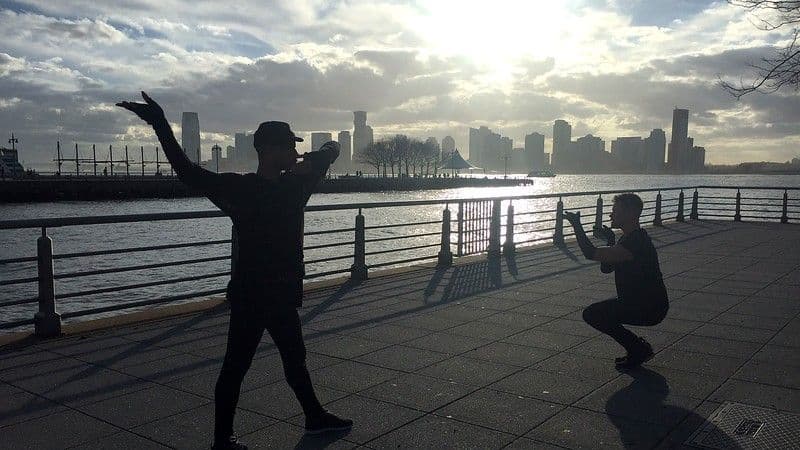
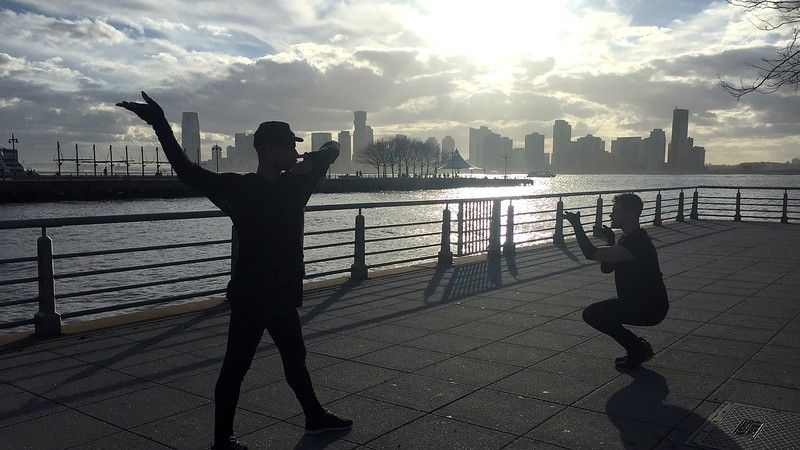
I propose choreonavigation as a practice-based method of wayfinding through maritime dance's legacies of colonialism, racism, "discovery" and resilience. This method treats choreography as a compass reading traces in the body to chart routes through memory, diaspora and place. The project emerged from my New York City pierdancing with Queer, Trans, Black, Indigenous People of Color, as a Romani voguing Irish step dancer orienting movement across histories, geographies and identities.
Choreonavigation emerged in my practice as I worked with maritime and migratory archives. I began to see how many "street" and "traditional" dance forms survive from the Atlantic world, which was full of dance coursing through land, ship and sea. In turn these choreonavigational practices still have the potential to act as countermaps to exploitative cartographies. I use step dance and task-based scores to "map" wayfinding, then build choreographies and storytelling with audiences, community and legacy.
Choreography as a compass, reading traces in the body.
The method works through task scores for embodied wayfinding, dance as indigenous countermap, and reflexive choreonavigational storytelling. It has taken the form of lecture-demonstrations and performance excerpts, a three-day online symposium and an academic article.
I introduced choreonavigation as a "wayfinding self" in the opening of my chapter "'This Little Wooden World': Choreo-Navigating Maritime Dance," in Celebrating Flamenco's Tangled Roots: The Body Questions, edited by K. Meira Goldberg and Antoni Pizà (Newcastle upon Tyne: Cambridge Scholars Publishing, 2022); a sample of the book is available as a PDF. I was also a co-collaborator on Celebrate & Recalibrate Flamenco at Coventry University, where on Day 3 I presented a walking paper—a performance paper—on space, place and protocols.