What is Choreography?
A study of choreography as the process of deciding what a body is allowed to do — module two of the Gypsy Fires Dance Library.
Module 2: Understanding freedom, control, and consent
What is choreography?
To understand choreography, let's return to our foundation: life as motion, existence as movement in time, and consciousness as how we express decisions through space and time. Historically, we have called people who devote time to understanding and furthering this dancers.
To understand the dancer, return to your memory from the first lesson. Focus on the person. How did they move? Did what they do feel wild or passionate? Highly skilled and controlled? Or maybe it was you, moving like no one was watching.
There are many people in the world devoted to the study, continuance, and evolution of dance. You may know a few famous ones, but most are fairly obscure. Many prefer to stay that way. It might seem strange that someone who knows something so intimately would choose to stay hidden. But if we want to know the true story of dance, it is also a story of permission, control, and bondage.
I am a Bashaldo Gypsy. That means my ancestors and I have come a long, long way to be with you here now. We are a deeply misunderstood people, largely because we are decentralized—we don't all have to think or do the same things to be who we are. In my family, we know what names and borders are, and how labels partition people. But we also remember that we are movement itself, and we honor what we carry through it. Historically, many powerful people have deeply disliked this mindset.
Dance in its simplest sense—a person in motion—does not need separation or division to function. It can actually break down when burdened by too many laws, rules, or restrictions. If we value the liberation we sense through dance, why would we let that movement stop?
To answer that, we have to explore choreography.
To understand the history and practice of dance, we must eventually confront danger. When you pay attention to how humanity moves, you notice there are things bodies are and are not allowed to do.
Sometimes it's subtle. The lady next to you in the grocery store could start clogging down the aisle, but she probably won't. It's not necessarily a question of desire; the tacit rules of public space dictate that banging the floor rhythmically isn't welcome. Someone created that social conditioning. Throughout history, figures went to extraordinary lengths to shape it—such as Kong Qiu (Confucius), who codified court decorum so that proper men walked without ruffling the long hems of their ceremonial skirts.
Cultural norms may seem benign, but history shows how what is "normal" can be gradually shifted over centuries into something else entirely: the body in manacles, fetters, or wooden clogs. This is the body in bondage, enthralled to another's will. Today, this might look like someone wearing a digital ankle monitor, or a child locked in a room against their wishes. Whether through physical chains or mental conditioning, control is everywhere.
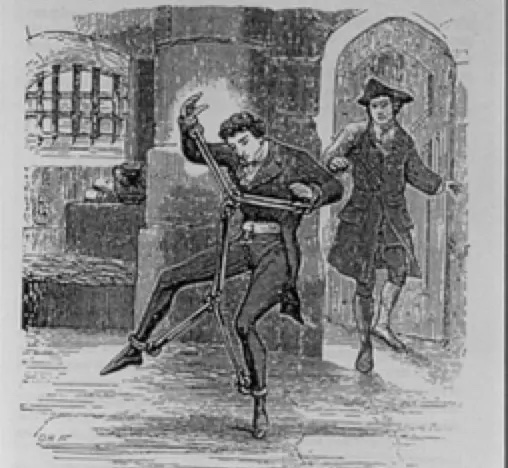
Engraving of a chained prisoner, artist and date unknown. Used in the Gypsy Fires letter "Looking for the Disappeared in the Dance of Fetters."
This might sound like an extreme spectrum—and it is—but control can easily be normalized. Regardless of the scale, the core questions of consent and freedom remain. The choice to have choice is still there, and the human drive to define the edges of our own movement endures.
Whether governance of the body is tacitly implied or brutally enforced, this regulation exists regardless of whether we consent to it. The process of deciding what a body is and is not allowed to do is called choreography.
The word choreography comes from two Greek roots: khoreia, meaning "dance" (from khoros, the dance ring or chorus), and graphein, meaning "to write." Literally translated, it means "dance-writing."

Title page of Orchesography, or the Art of Dancing by Characters and Demonstrative Figures
The idea that dance can be mapped or written has a long history, intimately tied to ballet—perhaps the most globally institutionalized dance form. Evolving from courtly dances in late medieval European palaces, these movements were systematically codified under King Louis XIV of France. He established a private guild of men who held exclusive authority to publish dance manuals. These were written in a specialized notation of lines, dashes, and squiggles, accompanied by treatises claiming medical benefits and historical authority.
From the perspective of much older global dance cultures, this was a novel, highly bureaucratic approach. Dance had historically been transmitted through the body itself—passed down directly from person to person, or parent to child, as in my family.
In one such manual from 1812, an author named Edward Taylor changed his name to E.A. Thaleur to sound more en vogue. He traced the history of dance through ancient Greece, Egypt, and Israel, claiming it had "fallen asleep" for a thousand years before waking up to be perfected in the courts of French royalty.
The essential takeaway is this: powerful institutions have invested immense time and money into defining what dance is, using dance-writing to claim ancient legitimacy. They call this process choreography, and the authority who dictates what bodies can and cannot do is the choreographer.
In the centuries since Louis XIV, these maps have spread globally—and with them, the premise that human bodies should be inscribed with the instructions of another.
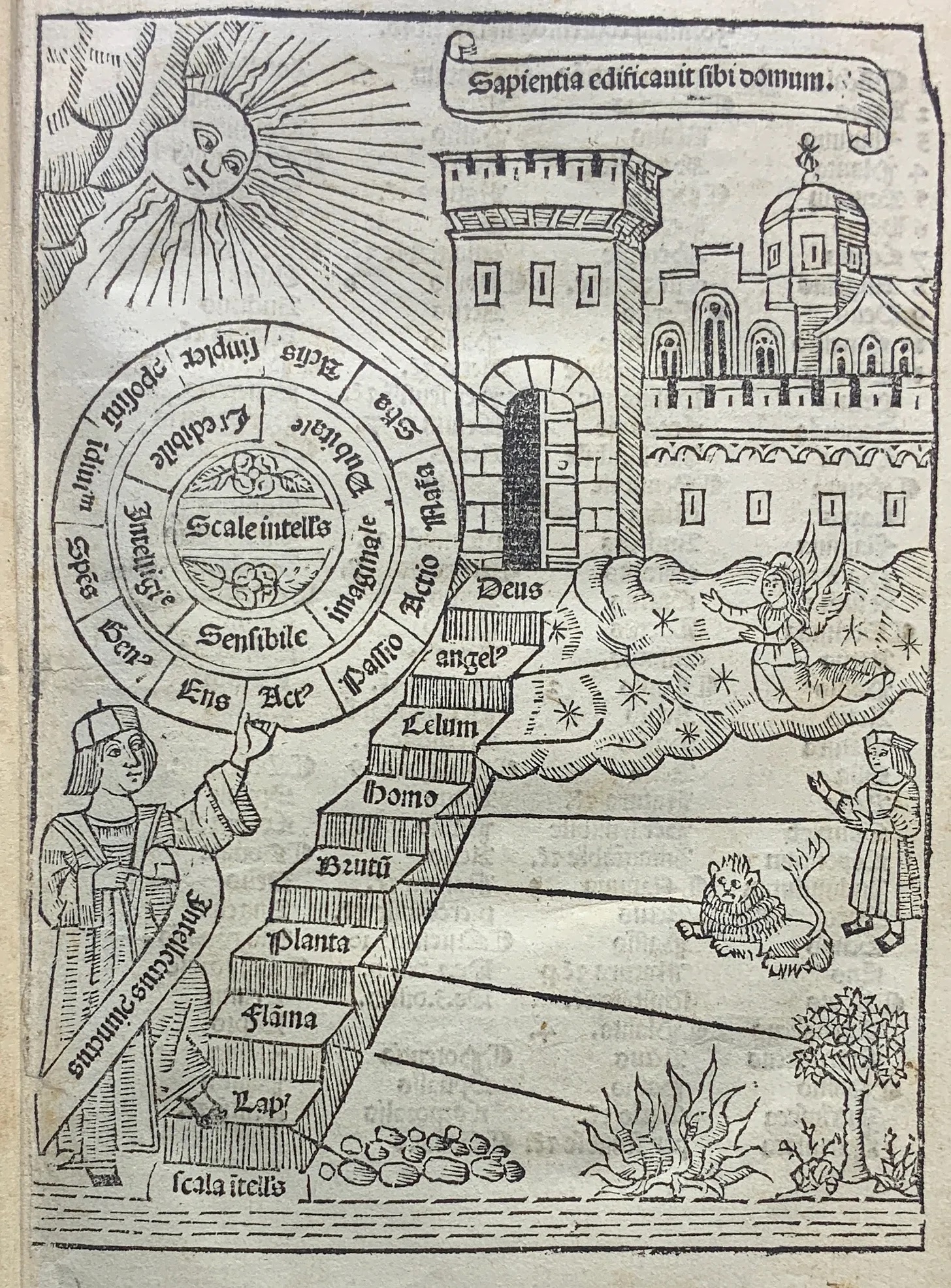
The Scala Intellectus from Ramon Llull's Liber de ascensu et descensu intellectus (Valencia, 1512). Creation ordered as a stairway: stone, flame, plant, animal, human, sky, angel, God.
The methods of control have evolved, often hiding in plain sight:
- A choreographer can be yourself looking in a mirror (just as Louis XIV did in the Hall of Mirrors at Versailles), evaluating what you do and do not approve of.
- It can be a director on a stage, where dancers agree to instructions for a paycheck.
- It can be a head of state, deciding who crosses a border and who is stopped permanently.
- It can be the unspoken code of fashion and public decorum, crafted through consumerism, religion, and politics.
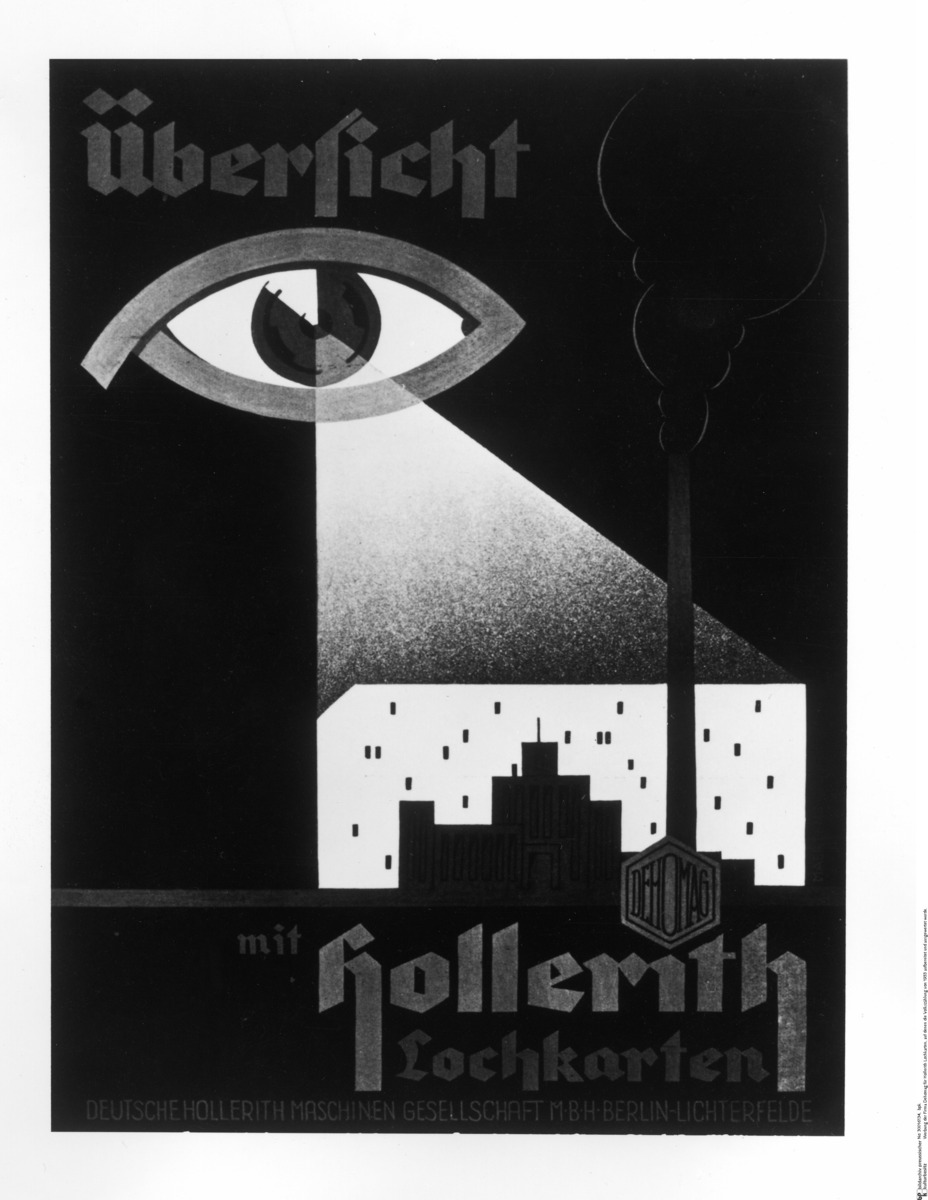
A Deutsche Hollerith Maschinen Gesellschaft advertisement: Übersicht mit Hollerith Lochkarten, "an overview with Hollerith punch cards." Hollerith systems processed anthropological and eugenic data on Roma and Sinti, aiding theft from them and their genocide.
Let's return one last time to our memory exercise. Set aside freedom, control, and consent for a moment, and focus on memory itself.
It is your memory of movement that creates movement's potential right now. It might be a move you saw someone else do, or your own signature rhythm on a dance floor. It can be deeper—a cellular memory that makes your arms shoot out when you lose your balance, or pull someone close when you love them.
Now, consider what happens if that memory is erased. Imagine your brain, your nervous system, and your muscles not only stopping certain movements, but losing the ability to recall them entirely.
This is remembrance itself being controlled. It is the most absolute form of choreography, because it persists long after physical restraint ends.
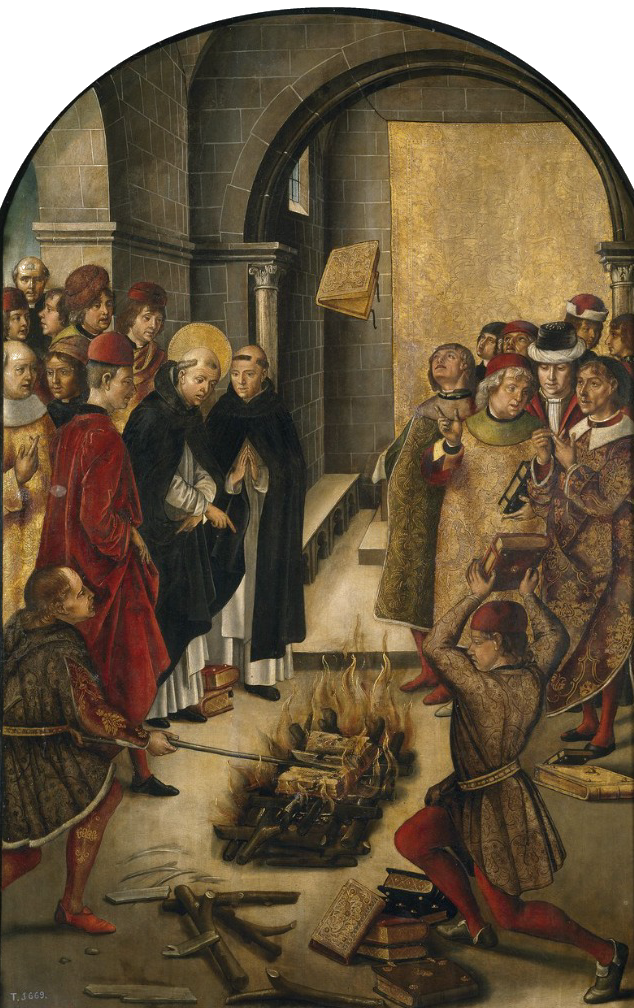
Pedro Berruguete, Saint Dominic Presiding over an Auto-da-fé (c. 1495), Museo del Prado. Books of the condemned are thrown into the fire.
This is the power of choreography.
Next Section: Entering the Practice (Coming Soon)
In the Library: Context & Further Reading
E.A. Thaleur — Elements of Musariche (1812) Historical Primary Source · A classic example of 19th-century European dance manuals that fabricated historical lineages to legitimize courtly dance systems.
Capoeira (Brazil / West Africa) Embodied Resistance · An Afro-Brazilian martial art disguised as an expressive dance ring (roda) to bypass colonial laws banning combat training among enslaved populations—a direct counter-practice to state choreography.
Aboriginal Australian Songlines & Dance Maps Global Spatial Memory · An ancient, living method of mapping geography, law, and history through dance and song, proving that spatial "writing" existed long before European notation systems, without relying on physical borders.
Japanese Butoh (Tatsumi Hijikata & Kazuo Ohno) Avant-Garde Performance · Emerging in post-WWII Japan, Butoh explicitly rejected Western ballet techniques and rigid notation, seeking instead to un-choreograph the body and allow suppressed, chaotic memories to surface.
Digital Ankle Monitors & Spatial Governance Modern Body Tracking · Contemporary carceral technology that uses digital parameters to dictate precisely where a physical body is permitted to step in real-time.


Keep the fire burning.
Stay up-to-date on upcoming announcements, classes, and gatherings. Weekly letters, practices, podcasts and stories from the fireside: embodied history, Romani philosophy and timedancing, delivered through the Gypsy Fires newsletter on Substack.
Listen on